- Event
- / Designing Truth
Designing Truth
From Truth(s) Regime(s) to Exosomatization
An Automedias.org, Networking Ecologically Smart Territories project, Université Paris Lumières & Jacob Institute for Design Innovation event
Jacobs Institute for Design Innovation, University of California, Berkeley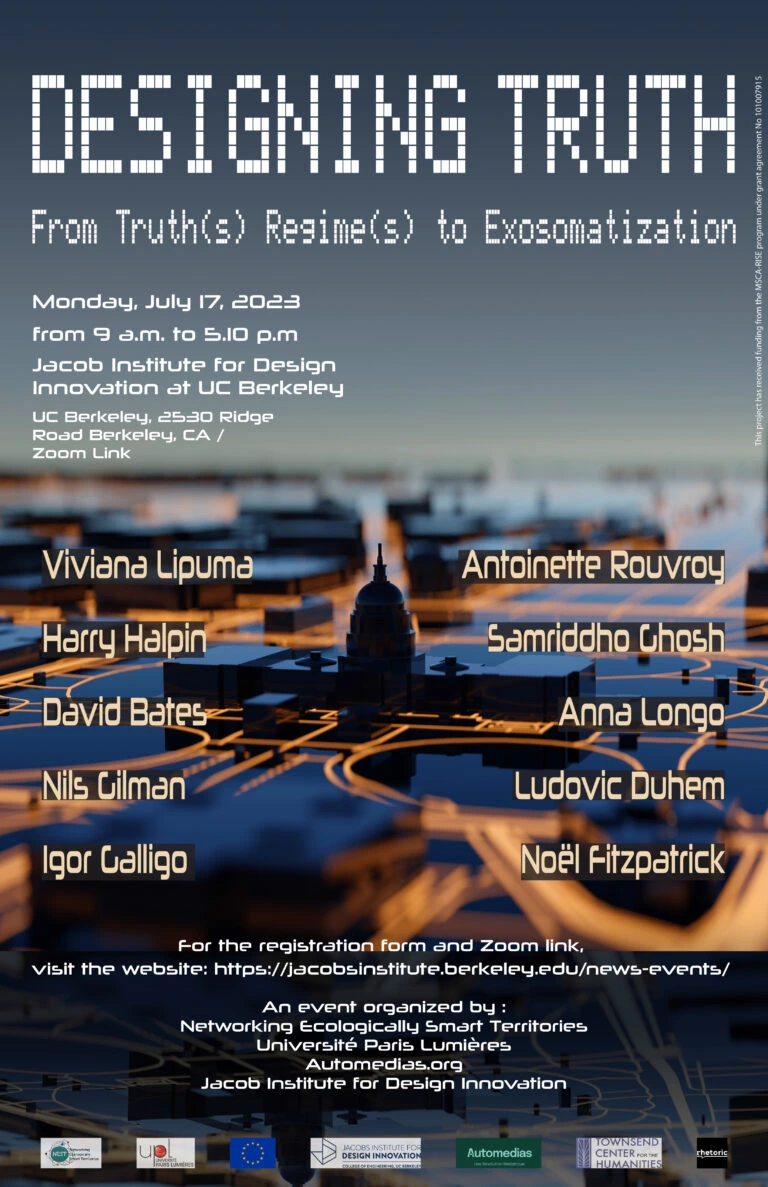
The aim of this symposium is twofold. Firstly, it will attempt to analyze the problems associated with post-truth (disinformation, misinformation, fake-news, conspiracy theories, etc.) on digital social networks not as the consequence of bad citizen behavior on the networks that should be moderated, regulated and banned, but as the negative effect of the globalizing imperialist strategy of big-tech that does not recognize locality as a variable in expressions of truth. In response to this analysis, the second challenge will be to promote the figure of the automedia and the creative process of exosomatization in platform design as alternative concept for overcoming the opposition between locality and globality, in order to resolve the political and epistemic tensions grouped under the name of post-truth. The aim is to rethink the concepts and production processes of digital social networks based on the cultural, social and geographical references of a given territory, aware of its singularity and its epistemic limits.
This project has received funding from the MSCA-RISE program under grant agreement No 101007915
Program
Day 1
One-day symposium
Opening the symposium
- 9:00 - 9:15Opening
By Igor Galligo
- 9:00 - 9:15
First Session
- 9:20 - 10:50Discussion
Computational capitalism: a politico-epistemic enterprise?
Talk 1 : Antoinette Rouvroy
Talk 2 : David Bates
Discussant: Anna Longo
Followed by collective discussion with the audience.Session moderated by & Igor Galligo
By Antoinette Rouvroy, David Bates & Anna Longo
- 9:20 - 10:50
Second Session
- 11:00 - 12:30Discussion
How can exosomatization territorialized information design?
Talk 1 : Ludovic Duhem
Talk 2 : Noël Fitzpatrick
Discussant: Viviana Lipuma
Followed by collective discussion with the audience.Session moderated by & Igor Galligo
By Ludovic Duhem, Noël Fitzpatrick & Viviana Lipuma
- 11:00 - 12:30
Third Session
- 14:00 - 15:30Discussion
Platform, territory and truth problems: what solutions for UX Design?
Talk 1 : Harry Halpin
Talk 2 : Samriddho Ghosh
Followed by collective discussion with the audience.Session moderated by & Igor Galligo
By Harry Halpin & Samriddho Ghosh
- 14:00 - 15:30
Fourth Session
- 15:40 - 17:10Discussion
Is computational capitalism part of the “post-truth crisis”?
Talk 1 : Nils Gilman
Talk 2 : Igor Galligo
Followed by collective discussion with the audience.Session moderated by & Igor Galligo
By Nils Gilman & Igor Galligo
- 15:40 - 17:10
Guests
Anna Longo
Doctor of aesthetics
Doctor of Aesthetic Philosophy. She is program director at the International College of Philosophy (CIPh, Paris) and affiliated with the Laboratory for Social and Political Change (EA7335 — University of Paris Cité). Deleuze, a Philosophy of Multiplicity, Paris, Ellipses, 2024. The Game of Induction.Antoinette Rouvroy
Doctor of Laws of the European University Institute (Florence)
Antoinette Rouvroy is permanent research associate at the Belgian National Fund for Scientific Research (FNRS) and senior researcher at the Research Centre Information, Law and Society, Law Faculty, University of Namur (Belgium). She is also member of the French CNIL (Commission Informatique et Libertés)’s Foresight committee. She authored Human Genes and Neoliberal Governance: A Foucauldian Critique (Routledge-Cavendish, 2008) and co-edited, with Mireille Hildebrandt, Law, Human Agency and Autonomic Computing: Philosophers of Law meet Philosophers of Technology (Routledge, 2011). In her writings, she has addressed, among other things, issues of privacy, data protection, non-discrimination, equality of opportunities, due process in the context of ‘data-rich’ environments (the so-called genetic revolution, the so-called information/surveillance society) with an approach combining legal and political philosophy. Her current interdisciplinary research interests revolve around the concept of algorithmic governmentality. Under this foucauldian neologism, she explores the semiotic-epistemic, political, legal and philosophical implications of the computational turn (Big Data, algorithmic profiling, industrial personalization). She explores the impact of algorithmic governmentality on our modes of production of what counts and accounts for “reality”, on our modes of government, and on the modalities of critique, resistance or recalcitrance.David Bates
UC Berkeley, Rhetoric Department
David Bates is professor at the Rhetoric Department, of the University of California, Berkeley. He received his PhD in European History from the University of Chicago. Since coming to Berkeley in 1999, he has been working on two main research tracks: one on the history of legal and political ideas, and the other on the relationship between technology, science, and the history of human cognition. He is now completing a book, An Artificial History of Natural Intelligence, that probes the emergence of human thinking as an entanglement of machine technologies, somatic processes, media practices, and social/political organization. Beginning with an examination of Cartesian robotics and early modern reflections on automaticity, he goes on to show how “artificial intelligence” in fact marks a peculiar stage in the history of reason, one that privileges the isolated mind and/or computer. A critique of contemporary models of automatic cognition requires unwinding a certain history of automaticity spawned by this moment, in order to rediscover another, longer history of the “human” constituted within and against technical systems.Harry Halpin
Professor
CEO of Nym Technologies, a company that aims to end mass surveillance. He is also a visiting professor at the American University of Beirut. He was involved in the Indymedia movement before earning a PhD in computer science from the University of Edinburgh and working at MIT under Tim Berners-Lee on decentralized social media standards. He completed his postdoctoral studies with Bernard Stiegler at the Institute for Research and Innovation and co-led the Nextleap project at INRIA Paris with Stiegler.Igor Galligo
Founder
Université Paris 8, Université de Technologie de Compiègne COSTECH , Université de Leuphana ICAM
Igor Galligo was born in France to families of French, Italian, and Tunisian descent. He received extensive university research education and experience in philosophy, the humanities and social sciences, as well as in art and design, in France (Paris Sorbonne University, Paris 5 University, Paris 8 University, Paris 10 University, EnsadLab, EHESS, ENSAPV, UTC Costech, Ministry of Culture and Communication DREST), Switzerland (IXDM, FHNW), Germany (Technische Universität Berlin; Leuphana Universität Lüneburg), and the United States (University of California, Berkeley). Regardless of the country or university, the research institutions with which he worked suffered from a problem of social representation. Most often, these institutions concentrated creative and production power according to cultures and forms imagined and designed by an elite, rather than according to democratic principles and rules in which other social groups could also find themselves reflected. However, his experiences working within social and cultural associations in working-class neighborhoods have shown him that it is not only possible to democratize the production of knowledge, arts, and technologies, but also urgent to work towards this goal in order to enable the collective construction of societies, beyond the issues of emancipation. To this end, he proposes thinking of democracy and democratization as questions and issues of production, that is to say, as questions pertaining to design, economics, and politics. This is what he is currently working on with Automedias. His aim is to collectively invent and experiment with new contributory designs of information, which must be new ways of informing and communicating in order to reshape the media production of democratic societies.Ludovic Duhem
Artist & philosopher
Ludovic Duhem is an artist and philosopher, his research focuses on the relationships between aesthetics, technology, and politics within the context of current ecological challenges. More specifically, he develops a “techno-aesthetics” for both human and non-human worlds through a relational, processual, and scalar approach, drawing on both contemporary post-phenomenological philosophy and the contributions of the humanities and life sciences. In parallel, he develops an eco-social theory of art and design applied to territory, based on social ecology, bioregionalism, and mesology. His artistic work centers on landscape as an expression of the tensions inherent in human-altered environments, which he formalizes through drawing, sculpture, and performance. He exhibits regularly in France and abroad.Haute Ecole des Arts du Rhin
Nils Gilman
Historian
Nils Gilman is an historian, futurist, and author who is Chief Operating Officer and Executive Vice President at the Berggruen Institute, a think tank based in Los Angeles. He holds a BA, an MA, and a doctorate in history from the University of California, Berkeley. From 2014 to 2017, he was Associate Chancellor at UC Berkeley. As an intellectual historian he is the author of Mandarins of the Future: Modernization Theory in Cold War America and Children of a Modest Star: Planetary Thinking for an Age of Crises. As a futurist, he is known as the cofounder with Rosa Brooks of the Transition Integrity Project. He is also a fellow at the Quincy Institute for Responsible Statecraft.Noël Fitzpatrick
Professor
Noel Fitzpatrick is a Professor of Philosophy, Academic Lead of GradCAM, Research Centre for Creative Arts and Media, he is Academic Lead of the European Culture and Technology Lab (ECT Lab+). He teaches Critical Theory, Philosophy and Aesthetics to undergraduate students at the school and supervises PhD students and Post Doctoral Candidates in the Faculty of Arts and Humanities . Noel is a Senior Marie-Curie Research Fellow with the GradCAM where he gives seminars on Phenomenology, Philosophy of Technology, Ethics, Aesthetics, Epistemology and Hermeneutics. He was also the Prinicpal Investigator for MSCA RISE ‘Real Smart Cities’ project (2017-2022) and MSCA RISE ‘Networking ecologically smart territories’ (2021-2025) and is Principlal Investigator on MSCA SE EPISTEAM (2023-2027).Samriddho Ghosh
Designer
Samriddho Ghosh is a designer hailing from Calcutta, India trying to create empathetic experiences for my users with the help of technology. During his undergrad, he co-founded a deep tech startup in the clean water domain, designing low cost water purification solutions for the underserved. Following this direction, he is keen to design meaningful solutions to advance in the realm of entrepreneurship.Viviana Lipuma
Philosopher
Viviana Lipuma holds a doctorate in aesthetics (University of Paris Nanterre), is a qualified teacher of philosophy, and is currently a postdoctoral researcher at the Federal Fluminense University (Brazil) and an associate researcher at the Johannesburg Institute of Advanced Studies (South Africa). She works at the intersection of political philosophy, art history, and the sociology of communication, with a particular focus on the neoliberal turn of capitalism, the crises it provokes in terms of mental, social, and environmental ecology, and the emancipatory potential of the visual arts. Drawing on reflections on clichés, semiotics, and control societies in the work of Deleuze, Guattari, and Foucault, she conducted a research project on critical media (Automedias, 2022–2024) and has notably published “Producing Reality: Images Tested by Their Political Efficacy” (Hybrid, 2017) and “From Mass Media Act to the Creation of Free Media.” What is a minority media strategy? » (Hermann, 2019), “The lures of post-media autonomy” (Cahiers Costech n° 6, 2024), “Territories. Expressive semiotics, nation and racism” (Ellipses, 2024) and “Politicizing desire in times of disaster” (Puf, 2025).
Ressources




- Dessin : Illustration
- Type : Epilogue, ETC
- Design : bnjm.eu
- Composé, dans un navigateur web, avec PagedJs